[The Stage is on Fire] is a page-turner in which, much like life, there are no easy answers and yet each step of the journey yields insight and hope. This work of heart must not be missed!
Melanie Faith
Creative Writing Teacher, Essayist & Poet.
Katie Steedly’s first-person piece [The Unspeakable Gift] is a riveting retelling of her participation in a National Institutes of Health study that aided her quest to come to grips with her life of living with a rare genetic disorder. Her writing is superb.
The Society of Professional Journalists
In recognition of receiving the Dateline Award for the Washingtonian Magazine essay, The Unspeakable Gift.
I thank you … It is the authenticity of your “class notes”; and it is the delicacy and skill with which you present the nuances of classroom life and the actuality of your students’ and fellow teachers’ lives.
Maxine Greene
Philosopher and Education Scholar
Enter your email here to receive Weekly Wide-Awake
back

Spit and Spaghetti #17
Pitches from Wind and Wall
Ghost Writer
A Surgeon’s Biography
Having independently published a memoir a few years ago, I understand the risk and reward of the process. From this side of the journey and having blogged and slogged through a writer’s life for many years, writing the memoir was (along with my doctoral dissertation which was a qualitative exploration of wide-awakeness in a high school Theatre classroom) a profoundly valuable experience.
I have unique insight into a medical journey. I am middle aged women living with Turner syndrome — a genetic condition in which a female is missing all or part of an X chromosome. My diagnosis was delivered when I was 15, following a year of pain, blood tests, and questions. It changed everything. I shrouded my diagnosis in silence for years — except when talking with my medical team — until I participated in a study at the National Institutes of Health, one of the few places in the world studying people like me. (I was living in Washington, DC at the time, right down from the National Institutes of Health, and decided to break my silence.) Here is my award-winning, Washingtonian essay — The Unspeakable Gift.
I live life downstream from my diagnosis. I am not even five feet tall. I struggle to reach the peddles when I drive and the top shelf at the grocery store. I have a dilated aorta and two heart specialists. I have witnessed thirty years of shifts and changes in hormone replacement therapy protocols — managing all the symptoms of menopause over time. I traded invincibility for vigilance before I got my driver’s license. My diagnosis taught me a few things. It invited me into a life that knew too much too soon— too many big words, too many specialists looking at every inch of my body, too many dreams changed before they were even imagined. It taught me who I am and who I am not — to learn, and relearn, that my diagnosis does not define me. It forced me to confront mortality. It gave me gratitude for it all.
Poetry Foundation
This Be The Place
“Artists and scientists are activists. They look at the world as changeable and they look upon themselves as instruments for change. They understand that the slice of world they occupy is only a fragment but that the fragment is intrinsically connected to the whole. They know that action matters.” ― Anne Bogart, What’s the Story: Essays About Art, Theater and Storytelling
Full Circle
This “This Be the Place” essay is a full-circle project. By full-circle, I mean my first “serious” writing experience, my master’s thesis almost thirty years ago, was an exploration of Anne Bogart’s Viewpoints (a theatre-based, critical performance theory.) I delved into the complicated conversation between theory and practice. Place entered my work when I first saw the B. Mifflin Hood Brick Factory building. This essay returns me to my roots, where I celebrate place, connect place and change, and craft a narrative whole from a complicated story.
Following A Few Rules: Paying Attention to McNeil and McCain (As They Pay Attention to Stein and Plimpton)
Choosing a subject — I have chosen my subject — B. Mifflin Hood Brick Factory — carefully. It anchors historical, political, and cultural narratives in relevance, significance, and context. My background as a researcher and teacher frames my interest in this story. Having spent significant time teaching writing in a men’s federal prison, I understand the connection between story, humanity, and justice. B. Mifflin Hood understood that same truth as he fought to end the brutal practice of convict leasing.
Be aware of plots and subplots — I discover plots and subplots in the B. Mifflin Hood Factory story every day. The plot centers of the work of B. Mifflin Hood and his effort to end the convict leasing practice. His successful business was built on innovation and our interdependent humanity. The subplots of historical restoration as storytelling, political activism in cruel times, and art as resistance run through the B. Mifflin Hood Factory story.
History is always cause and effect — The B. Mifflin Hood Brick Factory received historical designation in 2018. That validates the notion that history is always a cause-and-effect relationship — social activism yields positive change. The factory building, by its very presence, testifies to the importance of social justice work. I hear a call to action to share the story and apply the lessons it embodies to build a more just world.
The Gist
I live in a 100-year-old renovated factory loft next to a historically designated brick factory/art gallery, The B. Mifflin Hood Brick Factory. The brick factory caught my eye the minute I saw it. It is now a home and art gallery. As a naturally curious person — with researcher’s skills — I began to find out about the space. In digging around, the artist couple who lives there told me the story of the original brick company owner, B. Mifflin Hood. Hood advocated against convict leasing. That work provided the impetus for historical designation. This 1000-word story will explore — the power of paying attention to our next door, the lessons of art and history and place, and a future where place intentionally informs, connects, and inspires. I will take 2 months to complete a draft.
Saskatchewan Writers’ Guild
Living The Comma — A Few Things I Have Learned Teaching Writing Right Now
I have taught writing pretty much everywhere. I have written curricula focused on prompts, craft books, writing examples, student work, and community feedback. I have studied writing techniques, research methodology, and writing instruction. Currently, I write a weekly newsletter to the writing group I lead. (I have done this for the better part of a year.) Every week, I pull together a writing prompt from a favorite source, writing advice from a luminary writer, and a sample of excellent writing. This process has made me a better writer. I write more. I read more. I connect with other writers more. This article will synthesize the wisdom of my students — past and present, honor the writing process as creative and miraculous, and articulate the ways in which writing is thinking, and as such connects, instructs, and inspires. This article must be written right now as we desperately need to tell our stories, build relationships, and create the world in which we want to live. Writing can do all that.
Thanks for reading Spit and Spaghetti. Subscribe to the Wide-Awakeness Project to follow a writer’s journey.
Spit and Spaghetti #1
Spit and Spaghetti #2
Spit and Spaghetti #3
Spit and Spaghetti #4
Spit and Spaghetti #5
Spit and Spaghetti #6
Spit and Spaghetti #7
Spit and Spaghetti #8
Spit and Spaghetti #9
Spit and Spaghetti #10
Spit and Spaghetti #11
Spit and Spaghetti #12
Spit and Spaghetti #13
Spit and Spaghetti #14
Spit and Spaghetti #15
Spit and Spaghetti #16
About Katie

From Louisville. Live in Atlanta. Curious by nature. Researcher by education. Writer by practice. Grateful heart by desire.
Buy the Book!
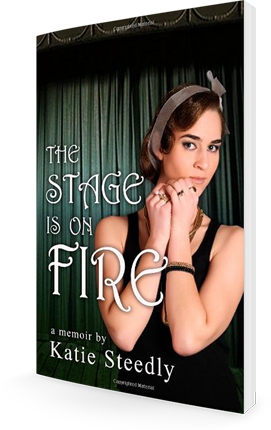
The Stage Is On Fire, a memoir about hope and change, reasons for voyaging, and dreams burning down can be purchased on Amazon.