[The Stage is on Fire] is a page-turner in which, much like life, there are no easy answers and yet each step of the journey yields insight and hope. This work of heart must not be missed!
Melanie Faith
Creative Writing Teacher, Essayist & Poet.
Katie Steedly’s first-person piece [The Unspeakable Gift] is a riveting retelling of her participation in a National Institutes of Health study that aided her quest to come to grips with her life of living with a rare genetic disorder. Her writing is superb.
The Society of Professional Journalists
In recognition of receiving the Dateline Award for the Washingtonian Magazine essay, The Unspeakable Gift.
I thank you … It is the authenticity of your “class notes”; and it is the delicacy and skill with which you present the nuances of classroom life and the actuality of your students’ and fellow teachers’ lives.
Maxine Greene
Philosopher and Education Scholar
Enter your email here to receive Weekly Wide-Awake
back

Living the Comma #51
Imagination #3. Radical Imagination. Getting Lost. Playing in the Dark.
Living the Comma
Living the Comma is a writers community connecting people with a creative process, a writing practice, and a spiritual path.
A theme ties the weekly Living the Comma newsletter with monthly meetings. Each theme will be explored in each newsletter and meeting. A weekly writing activity will be drawn from the monthly theme. Weekly writing activity responses can be shared in comments section to each newsletter and in monthly meetings.
Writers Hour — a weekly hour to write together — will commence again on Thursday, October 22nd from 12:00-1:00 EST and occur every Thursday from 12:00-1:00 EST through May. Join via this link.
Living the Comma Meeting Dates: September 1. October 13. November 3. December 1. January 5. February 2. March 2. April 6. May 4.
Meetings occur at Virginia Highland Church from 7:00 to 8:30 EST.
OUR NEXT FACE-TO-FACE MEETING WILL BE TUESDAY, NOVEMBER 3, 2026. Join via our VIRTUAL MEETING LINK if you cannot be present in person.
The Living the Comma newsletter is published weekly.
“We are brilliant at survival, but brutal at it. We tend to slip out of togetherness the way we slip out of the womb, bloody and messy and surprised to be alone. And clever — able to learn with our whole bodies the [ways] of this world.” — Adrienne Maree Brown, Emergent Strategy
Survival is imagination.
We are giving birth. Strength and courage are required. Brilliance and miracles are everywhere. Love and compassion are heart and bone. In awe we move through our days. When I pay attention, I often feel bloody and messy and surprised. I often long to dance with my shadow and do not know the steps. I often breathe and remind myself to stay soft. But that is not the entire story. I want peace. I want joy. I want to thrive.
We are giving birth. Imagination can help us find the beauty and possibility of now. Imagination can help us build relationship and connection. Imagination can help us see light in life’s cracks. I am reminded that we are born with imagination. We breathe and bond. We blink and focus. We point and flex. We grow and change. That is comforting at this time when everything feels huge. Paralysis and cynicism and overwhelm are not options. Imagination births something else. Certitude’s absolute smallness and truth’s narrow confines cannot contain imagination.
Radical Imagination
And what I realized is it is the work of radical imagination to do so [to teach us about how to be humans, and how to be humans in a better relationship with each other], but also that we’re living inside of imaginations that other people told us were true and told us, this is how the world is. And I always uplift my friend Terry Marshall. He was the first person to say this to me, that we’re in an imagination battle, which just blew my mind, and I think about it often; that we live in this abundant world, and we’ve been told it’s scarce. And then we’re given all these stories of scarcity. And because of that scarcity, we have to fight each other constantly. — Adrienne Maree Brown, On Being conversation, “On Radical Imagination and Moving Towards Life”
To echo Brown, imagination is abundant. It believes the proverbial pie expands. It believes in a perpetual dawn. It is not fixed and rigid and binary. It believes that ideas — like self and truth and time —are elastic and emergent and alive. It believes oneness includes all living things. Radical imagination is how we learn to live together justly, peacefully, and lovingly. Radical imagination is how we invent, build, and create. Radical imagination asserts new worlds are possible. In that way, an imagination battle seeks hope over fear, curiosity over sureness, and growth over stasis. The imagination battle is ultimately about the promise of beginner’s mind and the beauty of impermanence.
Same amongst humans — we’re just bags of water with the capacity to reason and spiritual callings. And we all have that. But if we imagine that we’re supposed to be divided and we imagine these constructs to live inside, we can get very committed to those constructs. And then our imaginations can get very limited, because it’s just like, ‘oh, what can I dream?’ … For me as a Black, queer woman, it’s like, what are the dreams that I can dream inside of the boxes of Blackness and queerness that someone else has constructed for me? And that’s never felt like enough room, because I’m a spirit, you know? I’m this massive energy like all humans are. So, so much of the work for me, of radical imagination is: what does it look like to imagine beyond the constructs? What does it look like to imagine a future where we all get to be there, not causing harm to each other, and experiencing abundance? — Adrienne Maree Brown, On Being conversation, “On Radical Imagination and Moving Towards Life”
Imagining a world beyond constructs — where there is enough room for all of us to exist together and experience true abundance — is the challenge of our time. How do we love and nurture the bags of water we are? Building the muscles of imagination looks like individual reflection, story collection, and community connection. Creativity — in whatever way creativity manifests — is the pulse of radical imagination.
A Field Guide to Getting Lost
“That thing the nature of which is totally unknown to you is usually what you need to find, and finding it is a matter of getting lost.” — Rebecca Solnit, A Field Guide to Getting Lost
Imagination depends on getting lost. As Solnit explains, finding what we need depends on getting lost. So, finding what we need depends on imagination. It is not counterintuitive to suggest a fundamental connection between being lost and imagination. Let me explain. Solnit contends, “Getting lost was not a matter of geography so much as identity.” Identity becomes the breath of imagination. Identity is where the battle of imagination takes place. In the constructs we use. In the stories we tell. In the memories we hold. Imagination and getting lost connect at the point of art. There is art to getting lost. Solnit suggests, “The art is not one of forgetting but letting go.” Imagination, at its core, is about letting go.
Playing in the Dark
“The subject of the dream is the dreamer.” ― Toni Morrison, Playing in the Dark: Whiteness and the Literary Imagination
I am a dreamer at heart. That probably explains my commitment to wide-awakeness. That probably explains my belief that words change lives. That probably explains my understanding that imagination may save us. Morrison describes, “I am interested in what prompts and makes possible this process of entering what one is estranged from—and in what disables the foray, for purposes of fiction, into corners of the consciousness self off and away from the reach of the writer’s imagination.” When imagination allows us to enter that from which we are estranged and journey into the corners of consciousness our lives change.
Writing and reading are not all that distant for a writer. Both exercises require being alert and ready for unaccountable beauty, for the intricateness or simple elegance of the writer’s imagination, for the world that imagination evokes. Both require being mindful of the places where imagination sabotages itself, locks its own gates, pollutes its vision. Writing and reading mean being aware of the writer’s notions of risk and safety, the serene achievement of, or sweaty fight for, meaning and responsibility. — Toni Morrison, Playing in the Dark: Whiteness and the Literary Imagination
Morrison explores imagination’s contours. Imagination means being alert and ready for beauty and elegance. Imagination means being mindful of sabotage and pollution. Imagination means being aware of risk and safety and meaning and responsibility. That is the peril and promise of dreams, commitments, and beliefs. That is finding what we need while letting go. That is radical imagination at its most powerful and poetic.
Writing Exercise — A Statement of Radical Imagination
Living the Comma Writing Exercises are inspired by the Beyond with Jane Ratcliff, The Isolation Journals with Suleika Jaouad, Letters From Love with Elizabeth Gilbert, the Mondays are Free writing project by Ross Gay and Patrick Rosal, The Clearing by Katherine May, and Writing in the Dark with Jeannine Ouelette communities.
Step 1: Brainstorm about Imagination
Take ten minutes and free write a list of words that describe imagination. Use words from all parts of speech. Excavate the corners of your dreams and memory to find words that distill imagination. Conjure words that describe imaginative people. Build one-word flashcards of imagination. Allow your thoughts to flow.
Step 2: Write an Imagination Field Guide
A field guide is a reference document designed to help people identify observable people, places, and things. Use that basic idea to develop an Imagination Field Guide. Start with your list of imagination words and write a field guide that allows people to find imagination in the everyday. Think of who, what, when, where, how. Think of details and description.
Step 3: Draft a Statement of Radical Imagination
From your list of words and Field Guide write a Statement of Radical Imagination. Your Statement of Radical Imagination can include all/none of — tenets of imagination, descriptions of imagination in action, examples of imaginative people, scenarios to cultivate imagination, or other avenues to approach supporting imagination in our world. Set your imagination free.
Step 4: Craft your Statement of Radical Imagination
Look at your Statement of Radical Imagination. Consider an audience for your Statement. To whom are you speaking? In what context will your Statement be delivered? What are the main ideas you want to include? How will you publish y0ur statement?
Step 5: Share your Statement of Radical Imagination
Take a moment to read your Statement aloud again and again and again. When/if ready, post your Statement in the comments to this message. Consider sharing it with our writing group on November 2nd.
We are energy. We have the capacity to create a better world. Imagine a reality beyond our current situation. Imagine we can care for one another and our earth. Imagine the future we want for our children and our children’s children, and our children’s children.
From the heart of the comma,
Katie
Thanks for Living the Comma. Subscribe to Living the Comma participate and connect with our community.
Living the Comma #44
Living the Comma #45
Living the Comma #46
Living the Comma #47
Living the Comma #48
Living the Comma #49
Living the Comma #50
About Katie

From Louisville. Live in Atlanta. Curious by nature. Researcher by education. Writer by practice. Grateful heart by desire.
Buy the Book!
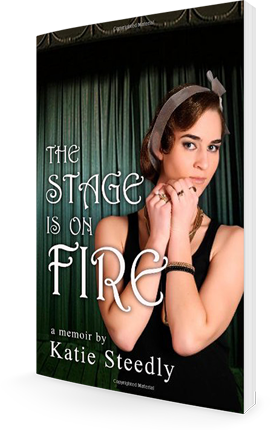
The Stage Is On Fire, a memoir about hope and change, reasons for voyaging, and dreams burning down can be purchased on Amazon.