[The Stage is on Fire] is a page-turner in which, much like life, there are no easy answers and yet each step of the journey yields insight and hope. This work of heart must not be missed!
Melanie Faith
Creative Writing Teacher, Essayist & Poet.
Katie Steedly’s first-person piece [The Unspeakable Gift] is a riveting retelling of her participation in a National Institutes of Health study that aided her quest to come to grips with her life of living with a rare genetic disorder. Her writing is superb.
The Society of Professional Journalists
In recognition of receiving the Dateline Award for the Washingtonian Magazine essay, The Unspeakable Gift.
I thank you … It is the authenticity of your “class notes”; and it is the delicacy and skill with which you present the nuances of classroom life and the actuality of your students’ and fellow teachers’ lives.
Maxine Greene
Philosopher and Education Scholar
Enter your email here to receive Weekly Wide-Awake
back
MONDAYS ARE FREE EXERCISES 146—150
Facts. Dedications. Acknowledgements. Browsing. Corrections.
EXERCISE 146: SKIP THE FACT CHECK STEP
the world without referring (resorting!)
Today you’re going to write a piece—poem, essay, essayette, monologue, whatever—about something you’re curious about and have some experience with, maybe even a little expertise, but you’re going to wonder about it in your writing in such a way—maybe you’d call it with enthusiasm or vivacity or rambunctiousness or rapidity or speculation—that your facts might not be entirely accurate. You might get some things wrong on your way to making something beautiful and true.
An Ode to Banyan Trees
There is a bayan tree in Brickell. It lives inside a park and outlasts hurricanes and development and vandalism and rising sea level and traffic and indifference. There is a bayan tree in Key West. It lives outside of Truman Annex and provides shade to wandering cats and roosters and tourists. You can stand beneath it and see the statue of people dancing outside of the Key West Museum. Banyan trees are sacred in Bali. Their roots are the resting place for human ashes and the host to spiritual offerings — a portal of devotion and transcendence. If you stop and look at Bayan roots, it is possible to get lost in twists and turns. It is possible to see where fragile meets formidable. It is possible to feel connected above and below. It is possible to understand what it means to survive storms. It is possible to believe in miracles.
EXERCISE 147: CONTRIBUTE TO THE LIBRARY CATALOG
the Library of Goodness is a dedication
Inscribed inside the cover of every book in the Library of Goodness is a dedication to a worker whose job you never thanked them for.
Recreate three cards from the library’s catalog, each of which records the book’s title (real or made up), the occupation of the worker to whom the book is dedicated, what their work consists of, and what they have made possible. (Caveat: you must know concretely what the nature of the work is; if you don’t, you must learn.)
Of Hyacinths and Biscuits — A Collection of Poems Exploring Goodness
This work is dedicated to lovers and dreamers. To wordsmiths and broken hearts. To shards and petals. To windows and doors. To economy and extravagance. To the fearful and the courageous. To those who crash and tell about it. To those who rise and tell about it. To those who craft and prune. To those who pay attention. To those who revel and reveal.
Love Letters From A Burning World — A Collection of Gratitude Conversations
This work is dedicated to those who write love letters to gratitude with their lives. To those who craft their days toward justice and goodness and love. To those who build and create. To those who imagine and hope. To those who refuse despair in a burning world. To those who plant seeds. To those who understand connection. To those who cannot keep from singing.
Feeding the Good Wolf — A Story of Art and Justice and Goodness
This work is dedicated to artists and Red Wolves. This work is dedicated to those who choose to feed the good wolf, especially when and where the good is not clear or easy or popular. This work is dedicated to those who restore and conserve and make. This work is dedicated to the deep roots of Progressivism that run through our country’s soil. This works dedicated to oneness — the idea that that animals and earth, people past present and future, and our stories and survival are interdependent.
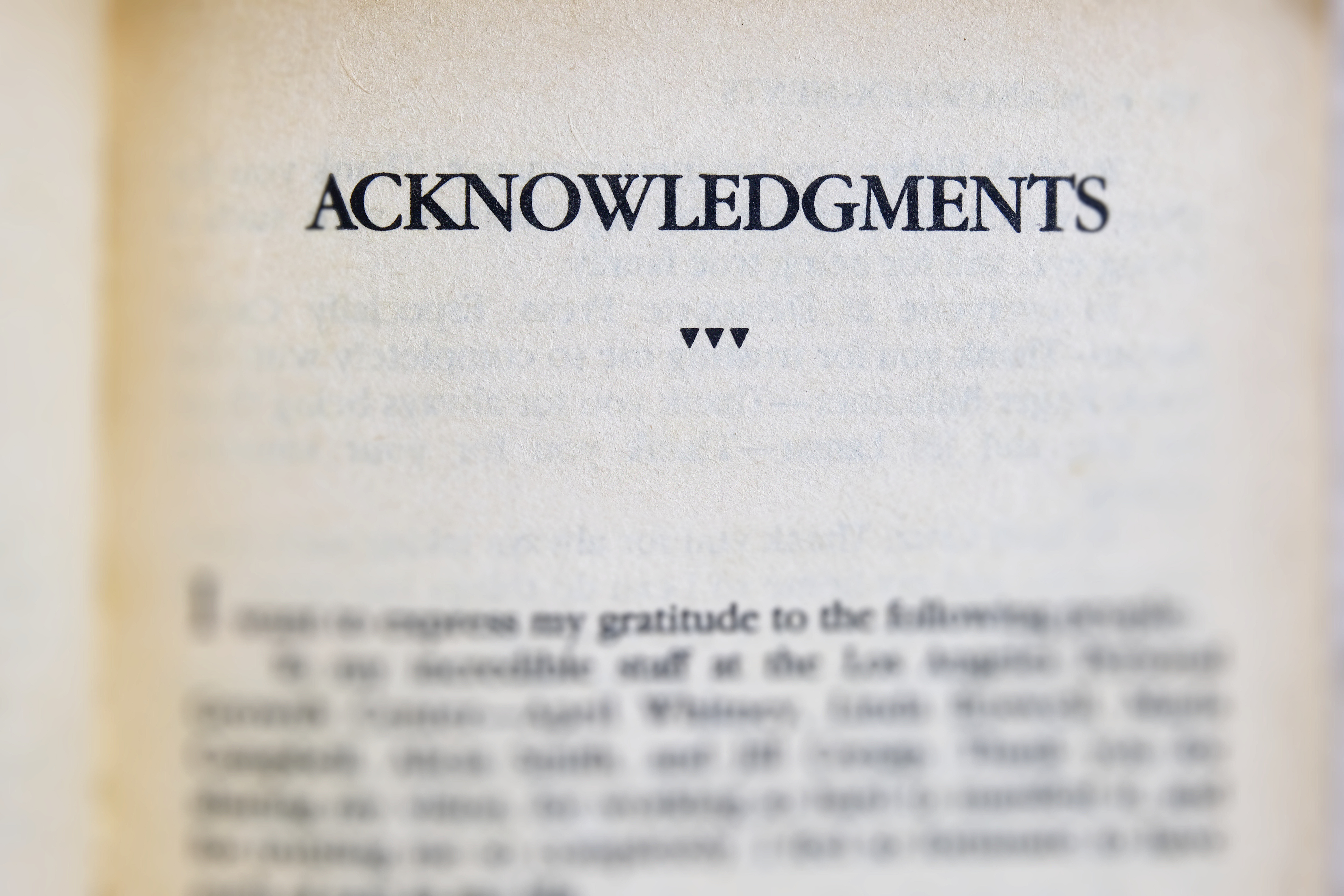
EXERCISE 148: WRITE AN ACKNOWLEDGEMENTS PAGE
who people thank, and how people thank
It’s not uncommon when first opening a book of poems or essays to flip first to the acknowledgments page, for reasons about which we could all speculate, but I suspect at least one of those reasons (or maybe this is two of those reasons) is that we love to know who people thank, and how people thank. Today, we’re going to write an acknowledgments page, which you might think of as for a book of poems or essays or stories, though you also might write an acknowledgements page that is general, roving, speculative, etc. Check out Danez Smith’s poem “acknowledgments.”
On Winning the MacArthur
Say I won the MacArthur. I am standing on the stage at an event where each MacArthur winner for that year gives a speech. I would start by thanking the Foundation for the award. I would thank the other award winners — past, present, and future — for their work and for their commitment to sharing their genius with the world. Because genius — what makes us each flesh and bone miracles — must be shared. Our lights must shine so all lights can shine.
I would then break it down to my personal genius journey (which will hopefully further make the point that genius must be lived and shared). I would thank my parents for teaching me to love words and people and service. I would thank my husband for the space to imagine and write and explore. I would thank every experience, even and especially the failures of which there have been many. Success and failure, the chewing and digesting of it all, is part of what it means to share our genius, to build meaning, to find our words, and do the work.
I have been fascinated for a long time with desire paths. I would acknowledge desire paths and the way life falls apart and back together. Many roads develop from desire paths that are worn one step at a time. In that way, desire paths are genius, like tides and constellations.
I would then speak the names of those on whose shoulders I stand — the artists, writers, musicians, philosophers, theologians, teachers, students, mentors who have shaped my capacity to look at the world and know in my bones the work that I must do. I would speak the names as a prayer for the as if and the not yet.
I would end with an invitation. I would invite everyone present to take a moment, shut their eyes, and softly speak the words “I am a genius” three times. As those words flash across the mind’s eye, as we briefly walk through our genius journeys in the time it takes to blink, the spirit and promise of the award lives a little more concretely. We begin to share our genius.
EXERCISE 149: BROWSE & COMPILE
Browse your ass off!
Get thee to a library or independent bookstore and start browsing. Browse your ass off! Maybe it’s in the poetry section, but maybe you browse extra browsingly, all over the place! Today you’re going to make a cento made of lines (sentences, phrases, or, if you’re feeling long-winded like I sometimes do, paragraphs) pulled from the books you’ve browsed. The only rules are 1. to not use a book from an author whose work you have previously read and 2. to have at least 10 lifted lines/phrases/paragraphs.
PS: A cento is a poem composed entirely of lines and phrases taken from other poets’ works.
Susan Sontag, Joan Didion, and Rebecca Solnit Walk Into A Bar
Hope is not a lottery ticket you can sit on the sofa and clutch, feeling lucky. It is an axe you break down doors with in an emergency. Hope should shove you out the door, because it will take everything you have to steer the future away from endless war, from the annihilation of the earth’s treasures and the grinding down of the poor and marginal … To hope is to give yourself to the future – and that commitment to the future is what makes the present inhabitable.
The likelihood that your acts of resistance cannot stop the injustice does not exempt you from acting in what you sincerely and reflectively hold to be the best interests of your community.
I think we are well-advised to keep on nodding terms with the people we used to be, whether we find them attractive company or not. Otherwise they turn up unannounced and surprise us, come hammering on the mind’s door at 4 a.m. of a bad night and demand to know who deserted them, who betrayed them, who is going to make amends. We forget all too soon the things we thought we could never forget. We forget the loves and the betrayals alike, forget what we whispered and what we screamed, forget who we were.
The stars we are given. The constellations we make. That is to say, stars exist in the cosmos, but constellations are the imaginary lines we draw between them, the readings we give the sky, the stories we tell.
We tell ourselves stories in order to live…We look for the sermon in the suicide, for the social or moral lesson in the murder of five. We interpret what we see, select the most workable of the multiple choices. We live entirely, especially if we are writers, by the imposition of a narrative line upon disparate images, by the ‘ideas’ with which we have learned to freeze the shifting phantasmagoria which is our actual experience.
The desire to go home that is a desire to be whole, to know where you are, to be the point of intersection of all the lines drawn through all the stars, to be the constellation-maker and the center of the world, that center called love.It hurts to love. It’s like giving yourself to be flayed and knowing that at any moment the other person may just walk off with your skin.
To paraphrase several sages: Nobody can think and hit someone at the same time.
We are imperfect mortal beings, aware of that mortality even as we push it away, failed by our very complication, so wired that when we mourn our losses we also mourn, for better or for worse, ourselves. as we were. as we are no longer. as we will one day not be at all.
Leave the door open for the unknown, the door into the dark. That’s where the most important things come from, where you yourself came from, and where you will go.
The magic of the street is the mingling of the errand and the epiphany.
EXERCISE 150: FACT CHECK
things you thought you were right about
The writer Brian Blanchfield, in his book Proxies (is this sounding familiar?), in which he writes his beautiful brainy essays full of facts and stuff without checking to see if all those facts and stuff were accurate, concludes his book with an essay called “Corrections,” in which, you guessed it, he makes the corrections to all the facts he got wrong in the essays. (It’s kind of an encyclopedia.) Today you’re going to write a piece called “Corrections,” which will consist of things you thought you were right about but were not.
Corrections
I thought it was possible to put toothpaste back in a tube. I thought all problems resolve. I thought all questions have answers. I thought watering saved houseplants. I thought milk would stay good in the fridge for a week. I thought habits form easily. I thought the muse would visit if I found the perfect time and place. I thought there was a perfect time and place. I thought it was easy to live in integrity. I thought there is a basic understanding of right and wrong. I thought everyone could agree on taking care of our young and old. I thought social progress only moves forward. I thought I would always remember my grandparents’ voices. I thought I would always remember the smell of tomatoes and watermelon and okra in July. I thought I would always remember what Mt. Rainier looks like when you fly into Seattle on a clear day. I thought I would always remember fields of bluebonnets and tulips and my grandmother’s rose garden.
MONDAYS ARE FREE 001 — 003
MONDAYS ARE FREE 004 — 006
MONDAYS ARE FREE 007— 010
MONDAYS ARE FREE 011 — 015
MONDAYS ARE FREE 016 — 020
MONDAYS ARE FREE 021 — 025
MONDAYS ARE FREE 026 — 030
MONDAYS ARE FREE 031 — 035
MONDAYS ARE FREE 036 — 040
MONDAYS ARE FREE 041 — 045
MONDAYS ARE FREE 046 — 050
MONDAYS ARE FREE 051 — 055
MONDAYS ARE FREE 056 — 060
MONDAYS ARE FREE 061 — 065
MONDAYS ARE FREE 066 — 070
MONDAYS ARE FREE 071 — 075
MONDAYS ARE FREE 076 — 080
MONDAYS ARE FREE 081 — 085
MONDAYS ARE FREE 086 — 090
MONDAYS ARE FREE 091 — 095
MONDAYS ARE FREE 096 — 100
MONDAYS ARE FREE 101 — 105
MONDAYS ARE FREE 106 — 110
MONDAYS ARE FREE 111 — 115
MONDAYS ARE FREE 116 — 120
MONDAYS ARE FREE 121 — 125
MONDAYS ARE FREE 126 – 130
MONDAYS ARE FREE 131 — 135
MONDAYS ARE FREE 136 — 140
MONDAYS ARE FREE 141—145
About Katie
From Louisville. Live in Atlanta. Curious by nature. Researcher by education. Writer by practice. Grateful heart by desire.
Buy the Book!

The Stage Is On Fire, a memoir about hope and change, reasons for voyaging, and dreams burning down can be purchased on Amazon.