[The Stage is on Fire] is a page-turner in which, much like life, there are no easy answers and yet each step of the journey yields insight and hope. This work of heart must not be missed!
Melanie Faith
Creative Writing Teacher, Essayist & Poet.
Katie Steedly’s first-person piece [The Unspeakable Gift] is a riveting retelling of her participation in a National Institutes of Health study that aided her quest to come to grips with her life of living with a rare genetic disorder. Her writing is superb.
The Society of Professional Journalists
In recognition of receiving the Dateline Award for the Washingtonian Magazine essay, The Unspeakable Gift.
I thank you … It is the authenticity of your “class notes”; and it is the delicacy and skill with which you present the nuances of classroom life and the actuality of your students’ and fellow teachers’ lives.
Maxine Greene
Philosopher and Education Scholar
Enter your email here to receive Weekly Wide-Awake
back
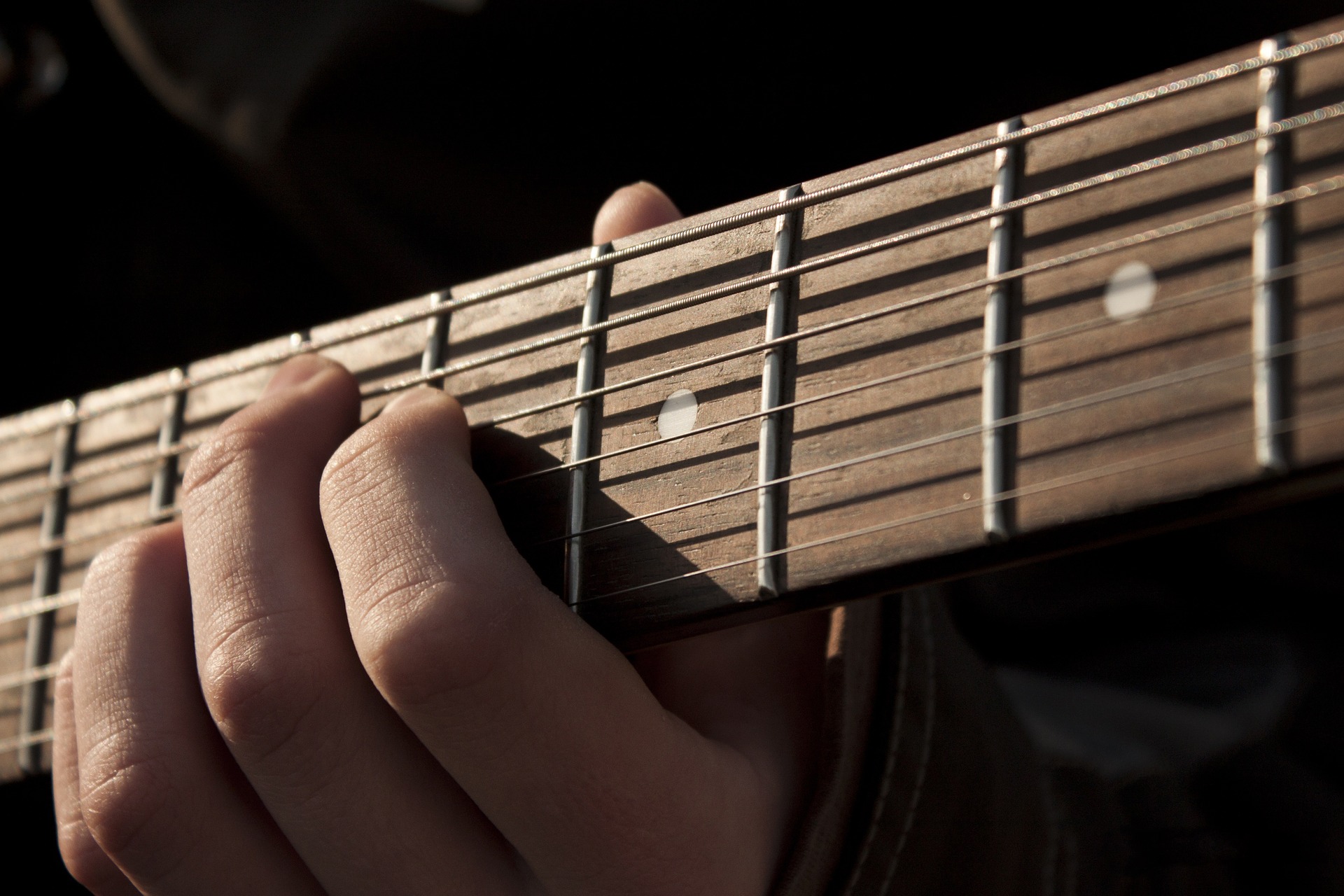
My Mother’s Guitar: A Gratitude Conversation With Roxanne Schroeder-Arce
Why Gratitude?
In 2017, heartbroken and eyeballs deep in despair, I started searching for things for which to be grateful. I asked myself the question asked by poet Katie Farris
“Why write love poetry in a burning world? To train myself, in the midst of a burning world, to offer poems of love to a burning world.”
I reached out to people who — in the way in which they live — write love poems to our burning world. I cast my net far and wide amongst my heroes — those I knew personally and those who teach us all by their example. I invited artists, philosophers, psychologists, politicians, professors, yogis, writers, clergy, and others into a dialogue about gratitude.
Roxanne Schroeder-Arce
Roxanne Schroeder-Arce is a teacher, scholar, administrator, arts advocate, playwright, and director. She has was named Dean of the Chaddock + Morrow College of Fine Arts and Professor at Ohio University in 2025. Before OHIO, she was Associate Dean of UTeach Fine Arts and Associate Professor of Theatre Education at the University of Texas at Austin. Her theatre practice is integral to her pedagogy. Schroeder-Arce’s bilingual plays have been presented to children and families in theatres around the United States. Her plays Señora Tortuga, Legend of the Poinsettia, Sangre de un Ángel, Mariachi Girl and Yana Wana’s Legend of the Bluebonnet (co-authored with María F. Rocha) are available through Dramatic Publishing. Her newest work, Lyric and the Keys, with music and lyrics by Jenn Hartmann Luck, premiered at the Magik Theatre in September, 2024. Professor Schroeder-Arce’s research interests include culturally responsive theatre education and Latino/a/x theatre for young audiences related to teacher training. She has published articles in journals such as Youth Theatre Journal, TYA Today, Theatre Topics, and Gestos. She has taught workshops on issues of diversity in theatre for young audiences and culturally responsive teaching artistry throughout the Americas and beyond. — Roxanne’s Website
Our Gratitude Conversation
KSC: What role does gratitude play in your day-to-day life?
RSA: So much of what I do, I am aware of how I got to be in a position to do it. I am a teacher. I am a professor. I get in my car every day and love what I do. Being a child from a family that had very little means–at least money–from a single mom, I am often thinking about people, like Upward Bound students. Upward Bound provided me access to education because my family couldn’t. My family did not understand how someone gets to college. My family did not think it was possible for me.
I am constantly aware of my responsibility to give back to others. I work to help others have access to education in many ways. I am already at a university, and my students are already university students, but they have to stay here. I have students who need to feel that they belong here. They are first-time college students themselves. It is hard to feel like you belong somewhere when the narrative of others around you is so different. While I am white, many of my students who are entrusted to me are students of color, specifically Latino students. I speak Spanish. I focus on Latino identity. I share that story of being a first-generation college student readily with intention. They know there is a professor who might understand what it is like to be in this space. Sometimes it is subconscious. I don’t realize what I am doing. I feel a great need to give back, or to give others what I feel I have received.
KSC: I think people come to gratitude in lots of different ways, and gratitude looks different to people, and manifests differently. I hear you connecting your understanding of gratitude with your personal mission. It is not so much a list of things, but it is how you walk your walk. It is your mission.
KSC: What are a few things for which you are grateful?
RSA: I am grateful for opportunity. If you gave me a million dollars, I would think of all the places I could travel, all the experiences I could have, and all the people I could have visit me. It is awesome to live in a world where I am constantly overwhelmed with what I have, rather than living in a world where I am constantly wishing I had more.
RSA: There are possessions for which I am grateful. My mom died eight years ago. I got many gifts from her: music, a witty sense of humor, and a carefree sort of attitude about things. I also now have her instruments in my house. When you walk into my house, the first thing you see is an entryway. That is our music room. Carlos has his drums. We have a piano that was given to us by our neighbors. We have my mom’s instruments. I play each. We have her guitar and her bass guitar. I learned to play bass guitar since I got her bass. We have people over and we play music. When she passed, she did not have much. She still lived in the trailer park in which I grew up. She did not have a lot of things that were of value except for these instruments. My family members wanted me to have them. I treasure them for a variety of reasons. I keep playing them, and feel close to her. I am grateful for that.
KSC: When I think about you, I think about music. You are music. If you were going to put a gratitude playlist together of songs for which you are grateful, or make you think of gratitude, what would your gratitude playlist be?
RSA: “You Are My Sunshine.” That is a song I sang at my mom’s celebration of life. The words. You are honoring what someone else brings into your world. That is definitely gratitude. “Tu Solo Tu.” I sang it to Carlos around the time we were getting married. It makes me think of Carlos, and how dedicated he is to me. “She’ll Be Coming Around the Mountain” has to be there. “The Joker.” That song makes me think of my sister. There is a song the kids sing in the summer at our indigenous cultures camp, and it is called “Na Ham Kaum.” It is about water. It is in Coahuiltecan, which is an indigenous language. It is about sacred springs. The water is sacred to our people. You appreciate the water. You take care of the water. We are all responsible for that. That song makes me think about being grateful for what we are given, and that cycle of ‘we take care of something because it takes care of us.’
KSC: Do you connect your gratitude with your creative process?
RSA: The different hats I wear, as teacher, artist, even researcher, it is not easy to divide them. I operate similarly in all of those spaces. I think that the characters that come out and say they want me to write them as a playwright are often this idea of access. Always in my work, appreciation for what you have is huge. Which is gratitude. Specifically, in Senora Tortuga, the mom says to the boy, to her son Pedro, “You have to appreciate what you have.” “What, like a barn, and beans and rice?” “Well we could be living in a box somewhere.” I think that the mother is really trying to inspire a sense of gratitude in her children.
That is the way I look at life. I appreciate what I have. I see my colleagues sometimes be frustrated with who has more, and how it is inequitable, and it is true. It is inequitable, and I fight for equity for others, but in my own life I can’t even believe what I have. It is just absurd. I don’t need any more. I think that is what that mother is saying to her son. So thematically, certainly [gratitude] is in my work.
RSA: This new play that I am writing, The Legend of the Bluebonnets, is just an honor to get to write. Do you know the book, The Legend of the Bluebonnets? It is an old legend. I am writing the play on the legend.
In the play, there is a little girl who has trouble at school. It is Native American Month. They are going to do a play, The Legend of the Bluebonnets. She goes and spends time with her grandmother who says, “Well actually there is a different story. That is not our version. That is the white person’s version of our native story.” The girl learns she needs to be telling her own stories.
The legend goes, that there was a little girl. There was a drought. The tribe was told, “You need to put forward your most valuable possessions, as a community, and then there will be rain.” The Creator said this to the people. The little girl had received this little doll from her grandmother before she died. She just knew that was her most prized possession. It was the only thing she had. She loved the doll. At night, she threw the doll onto the fire. As the fire turned blue, everyone went to sleep. No one saw her do this except for the chief who is watching from the hillside. In the morning, all of the rain is coming down. Her brother wakes her up, and they look outside. There is rain, and the bluebonnets just spread across the land.
I get to write this play. They are going to put this play in front of all these people. Specifically, brown children who need to see this play. I am just so lucky. How often do you get to do that? I am the luckiest person in the world, and so grateful for that opportunity. In that play, what draws me to it, is this idea that this child understands that what she has isn’t the doll. She has this connection to her grandmother. That is what she is valuing. That is the most critical. She realizes that the doll represents that, and she is still going to have that. She releases that, and then she still has it. It is not the doll. It is a beautiful connection. I think that speaks to me because it is about the idea of value. What do we value? What is important? What is important to me? If my mother’s guitar goes away, I have her music.
About Katie
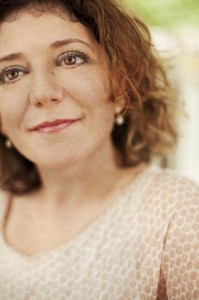
From Louisville. Live in Atlanta. Curious by nature. Researcher by education. Writer by practice. Grateful heart by desire.
Buy the Book!

The Stage Is On Fire, a memoir about hope and change, reasons for voyaging, and dreams burning down can be purchased on Amazon.